

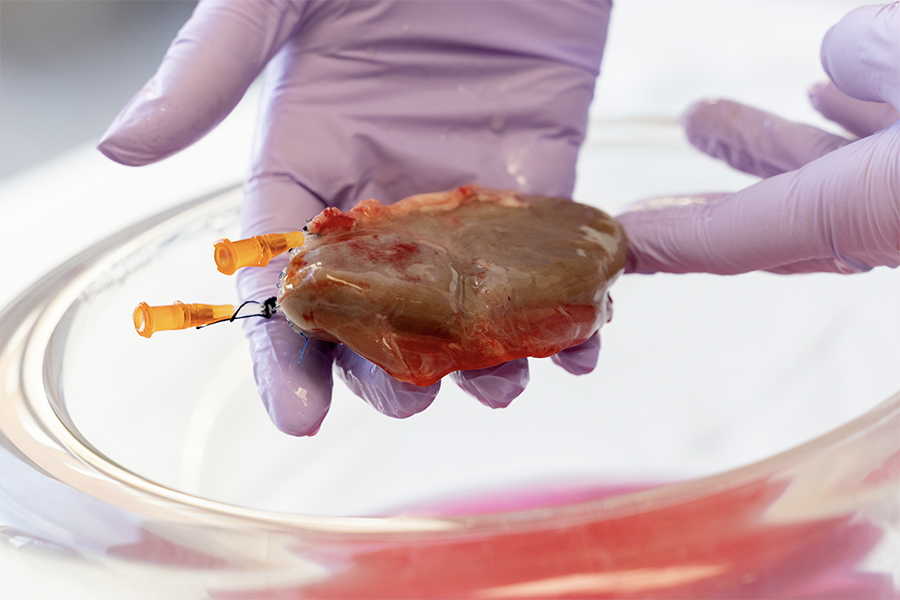

Right now a donated kidney has to be transplanted within hours. University of Minnesota researchers say they have kept pig kidneys in deep cold for months, 1 of them for more than a year, and then brought them back working. Erik Finger, the UMN transplant surgeon who co-led the work, said that after the last transplant he "walked out of the room and said, 'This is a big deal.'"
Strictly speaking the kidneys weren't frozen. They were vitrified: the team soaked the tissue in a chemical cryoprotectant and cooled it to -150°C (-238°F), turning it into a glass-like solid without forming the ice crystals that tear cells apart. The researchers said the organs stay stable at -120°C or colder. Rewarming is the hard part, and it's where UMN's engineers came in. The team mixes iron-oxide nanoparticles into the cryoprotectant. The particles conduct heat and electricity, so the organ's tissue warms evenly back to room temperature instead of cracking.
After rewarming, the kidneys were tested on perfusion machines and transplanted into pigs. "They pink right up," Finger said. Urine production started within minutes. The kidney that had been stored for over a year made urine immediately on the perfusion machine. "We're comfortable now saying we can store them for a year," Finger said.
There's an important qualifier. The kidneys made about 2/3 of the urine a healthy kidney would, and they showed signs of injury, which the team attributed to the toxicity of the cryoprotectant. The researchers haven't yet shown that the kidneys work long-term in a living recipient. The work was posted to the preprint server bioRxiv and has not been peer-reviewed.
This study builds on earlier UMN work. In 2023 the same group reported that vitrified rat kidneys stored for up to 100 days could be nanowarmed and transplanted, the first time scientists had repeatedly transplanted a life-sustaining mammalian organ rewarmed this way. Scaling up was a big jump: rat kidneys are about the size of a quarter, while the pig kidneys are close to human size, around 100 grams. "We had to rediscover and modify the cocktail," Bischof said, referring to the cryoprotectant.
The project is part of ATP-Bio, the National Science Foundation's Engineering Research Center for Advanced Technologies for the Preservation of Biological Systems. Bischof directs the center, which is based at UMN, and Harvard Medical School's Mehmet Toner is deputy director. In 2025, the center reported transplanting a pig kidney that had been stored for 10 days at -15°C. It said then that about 20% of donated kidneys go unused each year because they can only be kept on ice for a few hours.
Those numbers explain why people outside the lab are paying attention. More than 100,000 Americans are waiting for an organ transplant. Banking organs for a year would give hospitals time to match donors with recipients and move organs across the country. Harvard Medical School's Korkut Uygun said, "It is a revolutionary time for transplantation." The UMN team's next step is experiments with human kidneys. They haven't given a timeline, and scaling up the process remains a challenge.