


Earth had started the slow slide into its next ice age. Then the smokestacks got there first. That's the finding of a new study published October 22 in the journal Science. It traces the history of the Barnes Ice Cap on Canada's Baffin Island, which is one of the last remnants of the great North American ice sheet.
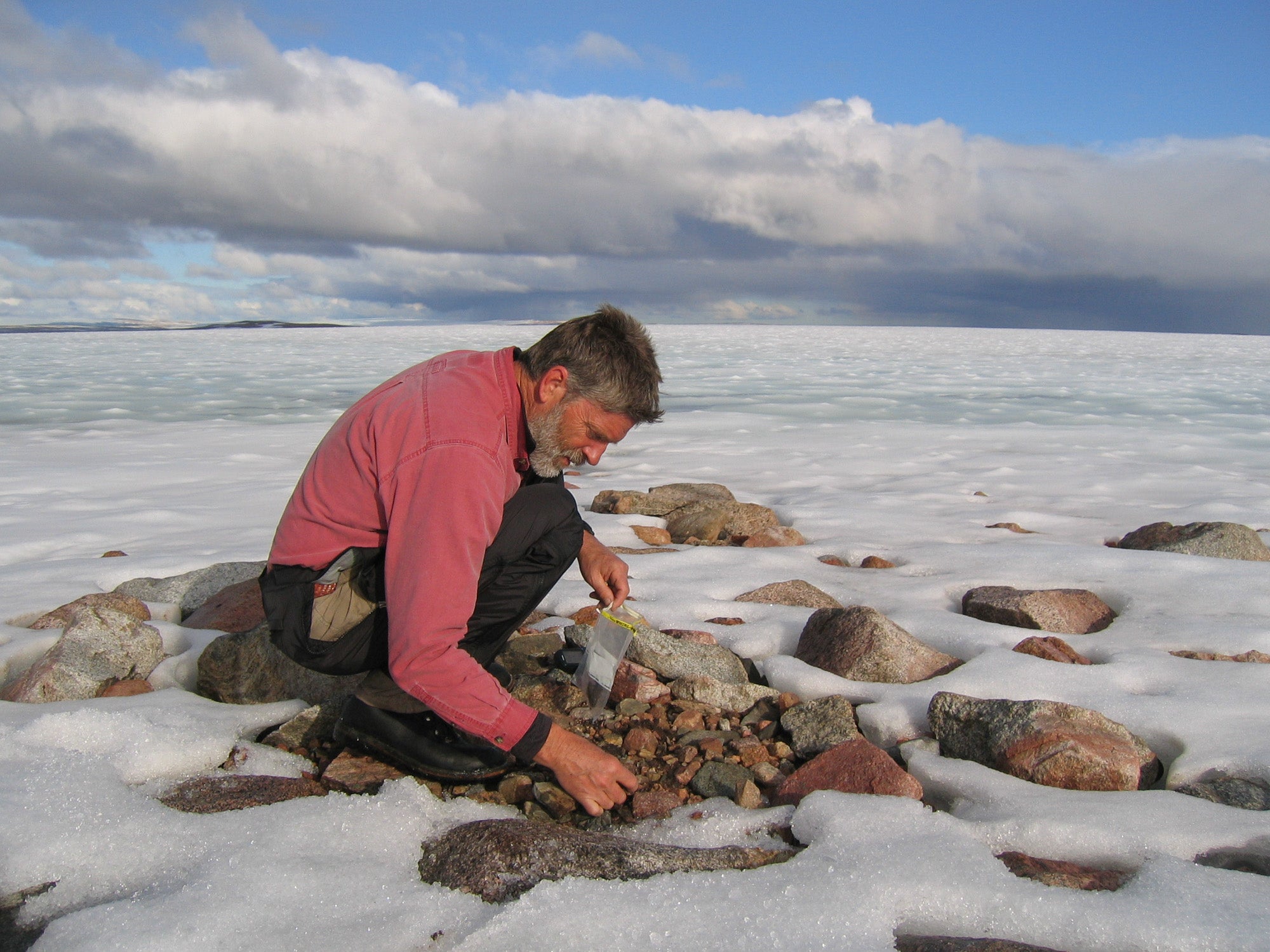
The research team was led by Nicolás Young of Columbia University's Climate School and included Gifford Miller of the University of Colorado Boulder's Institute of Arctic and Alpine Research. They collected dead moss and shrubs that had been exposed at the ice cap's retreating edge. Radiocarbon dating of those plants showed when the advancing ice had buried and killed them. The team also measured isotope ratios in rock cores to work out how long the ground had been covered by ice.
Here is what they found. After thousands of years of shrinking, the ice cap started growing again sometime in the last 1,000 to 2,000 years. It kept growing until about 1960. Then rising summer temperatures began melting more ice each summer than winter snow could replace. Researchers interpret that earlier growth as the start of a new glacial period, cut short by greenhouse gas emissions even though the summer sunlight reaching the region was still declining. "Without greenhouse gas forcing, we would be moving slowly but steadily into an ice age," Miller said.
The ice cap is shrinking fast. Its edge pulled back roughly 200 to 800 meters between about 1960 and 2022, and it has had no accumulation area since 2010. That means no part of the ice cap now gains more snow in a year than it loses. Models project that the Barnes Ice Cap will melt away completely within the next few centuries.
WIRED asked Andrew Wickert, an associate professor in UMN's Department of Earth and Environmental Sciences, to put the study in context. Wickert said the research shows that "even as we were just starting to ramp up emissions, we've already done enough damage to cause the major North American ice sheet to already start retreating." He also pointed out that the ice cap's edges have retreated an average of 4 meters per year since the 1980s, as carbon emissions climbed quickly.
This is Wickert's field. His research covers how ice sheets and glaciers grow and decay and how they interact with climate, along with sea level and glacial geology. He joined the Minnesota faculty in 2015 after earning his PhD at Colorado Boulder, home of Miller's institute. He is also affiliated with the St. Anthony Falls Laboratory. Students curious about the deep-time side of climate change can find his work through his faculty page.
For Minnesotans, the background is familiar. Ice ages come and go on a schedule set by natural shifts in Earth's orbit and tilt, known as Milankovitch cycles. Glacial periods alternate with warmer interglacials, when the ice pulls back toward the poles. The new study suggests the next one had started to form and that people stopped it, without meaning to, by burning fossil fuels.