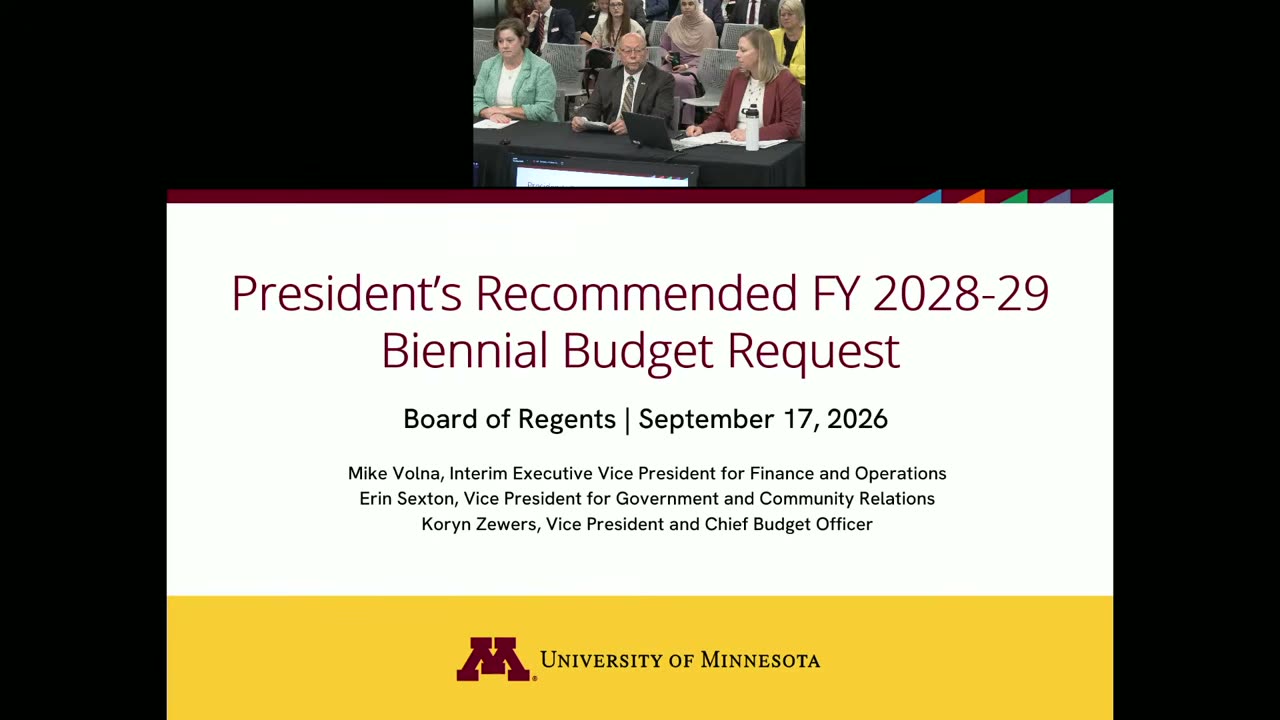
President Rebecca Cunningham presented her recommended biennial budget request to the state, totaling $85 million in recurring funds across five requests. The largest is $54 million for statewide operations, mostly to cover inflation on utilities, public safety, technology and compliance. The other four are $15 million to graduate more health care workers, $10 million for a statewide AI strategy tied to the new AI Hub, $3.5 million for a Career and Workforce Accelerator, and $2.5 million for market-responsive online learning. Officials said the last biennial request was $235 million and called this one deliberately focused. The Board reviewed it and will act at its October meeting through the finance committee.
Finance officials told regents the university's recurring state funding has lost $89 million in purchasing power over the last two bienniums, after flat appropriations and a cut in FY2026. They said higher education's share of the state budget has fallen from 9% to 6% over 20 years. The university's base operations and maintenance grant is about $644 million. The interim finance chief said operating costs were cut nearly 9% over three years, and that tuition increases and internal cuts can no longer close the gap without harming the core mission. Officials also cited uncertain federal research funding, softer graduate and international enrollment, and Minnesota high school graduates having passed their peak.
Answering regents, Cunningham said the drop in 18-to-22-year-olds will not reverse in the Midwest for years. She said no one expects higher education funding to return to 2018 or 2010 levels, calling it a 'tectonic' change for the industry. She said that even if the state fully funds the operations request, the university will still be more than $100 million short over two years. Leadership groups will meet in the coming weeks on further prioritizing across all units and campuses. A regent urged a review of spending that may not serve students, saying the university 'cannot merely cut ourselves to prosperity.'
During the budget review, a regent cited recent warnings from AI companies about the technology's dangers and the lack of federal regulation. The regent asked whether the university's AI Hub could help address them. Cunningham said students must graduate AI-fluent and the state workforce needs upskilling. She said the hub can also lead on ethical, human-centered and responsible use. Another regent urged the university to help shape AI policy and regulation and to bring general counsel and employers into the conversation.
The administration previewed three capital asks for the 2027 session, which officials noted is not a traditional bonding year. The top priority is a $150 million new academic building at UMR in downtown Rochester: $100 million from the state and a $50 million university match. It would help grow enrollment toward 2,500 students and house the National Institute for Learning Innovation. The second ask would modernize 50-year-old School of Dentistry clinical space in Moos Tower; the school trains 73% of Minnesota's practicing dentists. The third is $50 million in HEAPR funds for health, safety and infrastructure repairs. Officials said tight bonding capacity may require creative financing, such as university-issued debt backed by state appropriations. The Board will vote in October.
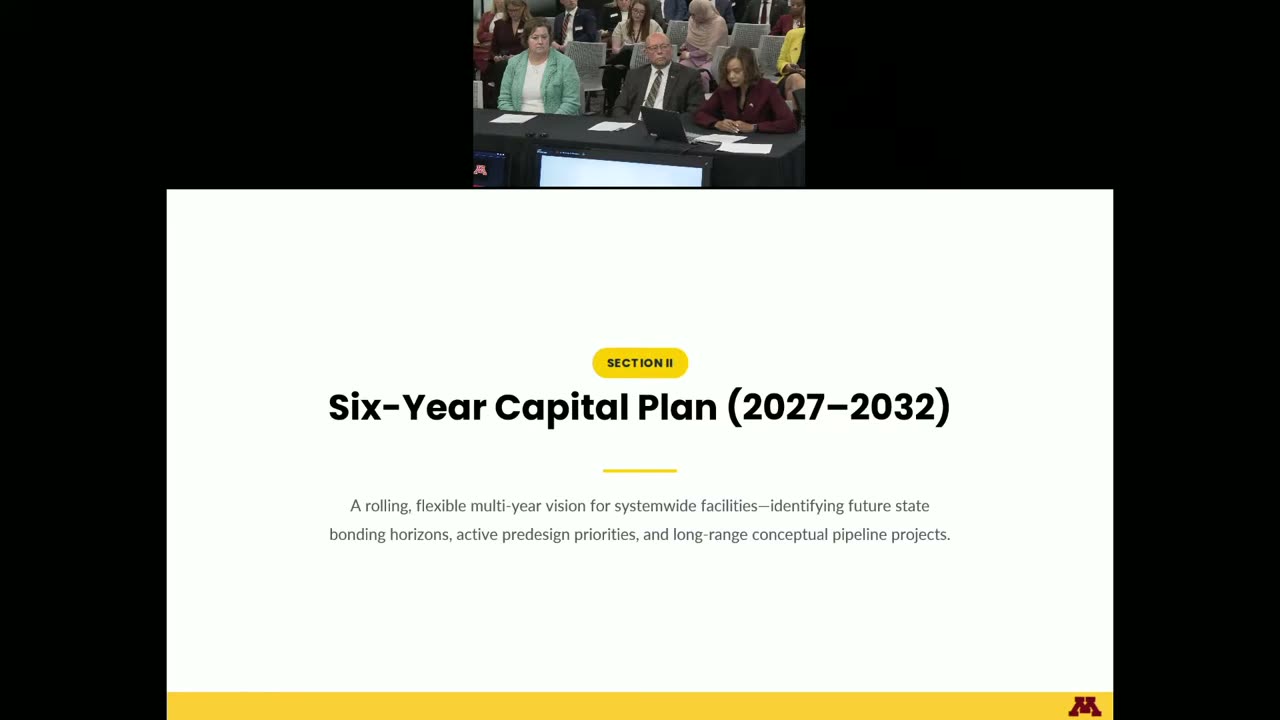
Leaders presented a rolling 2027-2032 capital plan, deliberately pruned from past years' long lists. Officials stressed it grants predesign authority only and is not a funding or construction commitment. Projects in predesign include new student housing and active learning classrooms on the St. Paul campus, and space-consolidation work involving Diehl Hall aimed at decommissioning outdated Twin Cities facilities. A redesign of UMD's Large Lakes Observatory is also in predesign. Cunningham said a long-discussed Duluth health care education building remains 'under consideration' and needs a clearer program and ongoing funding plan. Regents praised the Duluth medical education push and the Natural Resources Research Institute.
Asked where the university's capital match comes from, Cunningham said the old formula of two-thirds state and one-third university no longer reliably holds. Whatever the state does not provide must come from the unit's reserves, fundraising or university funds. She said the university has set aside new funds for its own debt capacity, so some planned projects will not be state requests at all. She also said she is working with foundation leadership to shift fundraising toward buildings, after past focus on scholarships.