In the news
The interim vice provost for artificial intelligence updated the committee on the AI Hub, launched April 22. The hub has rolled out AI literacy training for incoming students and staff, launched ai.umn.edu, and is expanding access to AI tools including ChatGPT and Anthropic tools, with paid access tied to a chart string. It also announced a universitywide AI forum for late February. Regents pressed on common-sense AI regulation, workforce displacement, the digital divide, and the risks of relying on multiple AI vendors.
Following this: AI Hub reports early progress as Cunningham says every graduate must be AI-literate
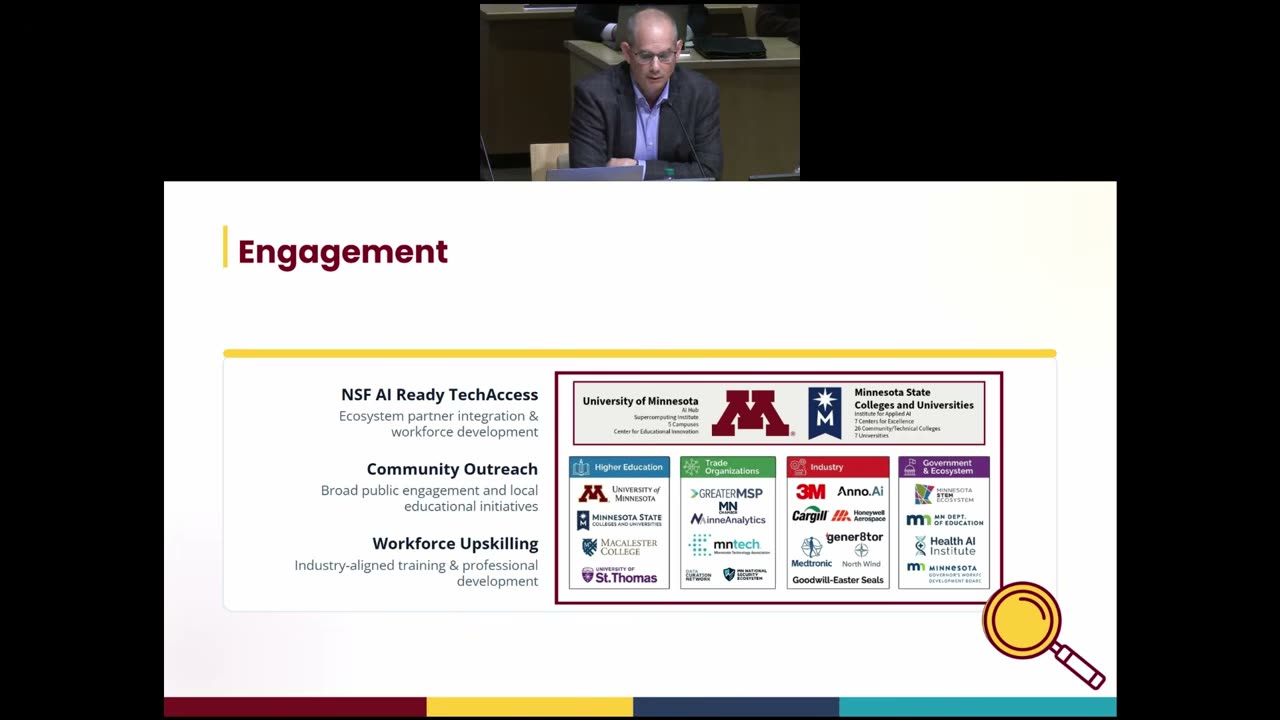
The university led a coalition with the Minnesota State system and industry, government, and trade partners on a National Science Foundation 'AI Ready America' proposal. The proposal has advanced to the final round, but no award has been made. Officials said they would reapply in December if it is not funded, and that some planned work, such as a statewide AI strategic plan with state agencies, will go ahead regardless. A separate infrastructure proposal with the North and South Dakota systems is also being developed.
Following this: U of M-led coalition with Minnesota State is a finalist for NSF 'AI-Ready America' grant
Responding to a student representative's question about bringing AI into classrooms, AI Hub leaders said faculty will not be required to use AI and retain academic freedom. President Rebecca Cunningham noted that the board's strategic plan sets a metric that all students graduate with discipline-appropriate AI literacy and fluency, and said the board will track it. AI Hub leaders also cited a September U.S. Census Bureau report finding that graduates in AI-exposed majors face recession-like job effects.
Following this: AI Hub reports early progress as Cunningham says every graduate must be AI-literate
Provost Ritter outlined a proposal developed by the vice provost for undergraduate education under which every new Twin Cities student would take a first-year experience course. Options would include a three-credit seminar with a peer-mentor component, an international immersive gateway seminar, or an existing college-specific course. Presenters from Crookston, CFANS, and Duluth described current programs; CFANS reported higher retention, about 98% versus 91%, among students who took its first-year course. No action was taken; it was a discussion item.
Following this: Provost floats a required first-year seminar for every new Twin Cities student
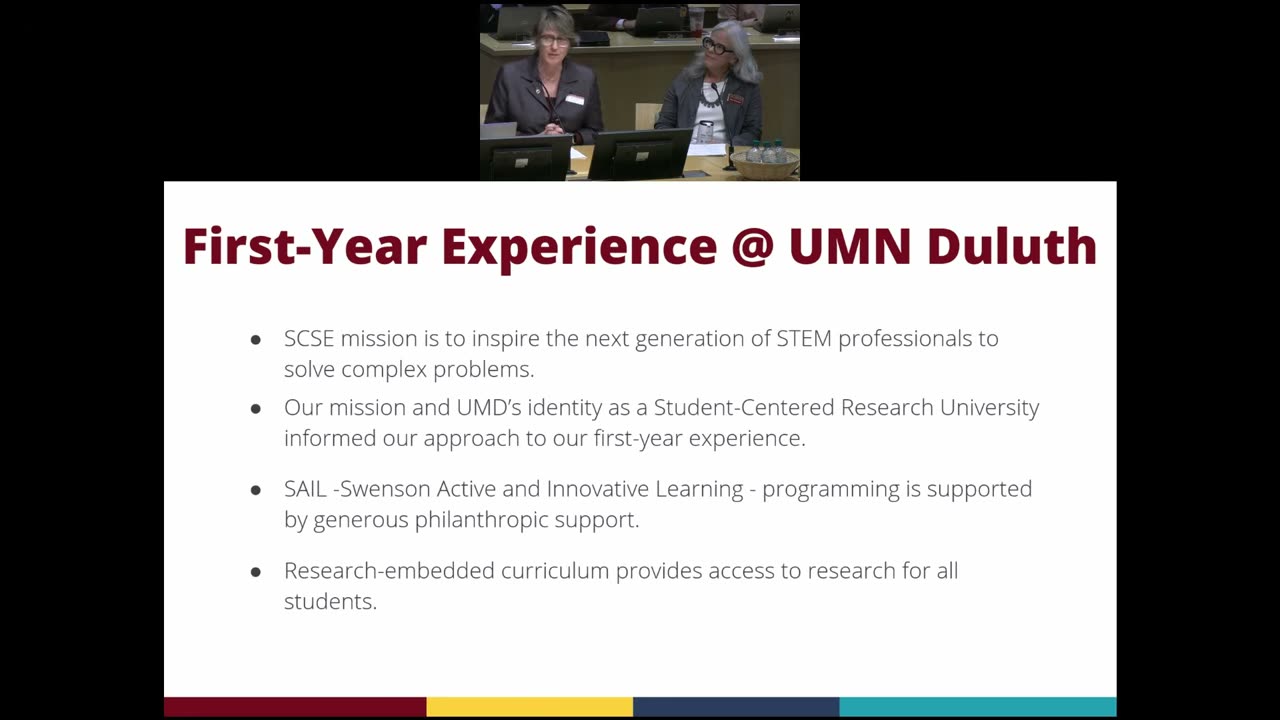
The dean of UMD's Swenson College of Science and Engineering described the SAIL (Swenson Active and Innovative Learning) initiative, now in its fourth year. All 10 departments have redesigned their freshman gateway courses to include research or engineering design, and more than 3,000 students took part last year. The program is funded by the Swenson Family Foundation, and the dean said it is improving retention and drawing interest from employers.
Answering a regent's question, Provost Ritter said a systemwide working group recommended aiming for a 90% on-campus housing requirement across all five campuses, citing benefits for student success, belonging, and mental health. Rochester already has a two-year requirement, while the Twin Cities campus has none, and administrators are working on how to get there. A regent framed first-year investments against 'harsh budget realities' expected over the next three to four years.
The committee approved, by voice vote with no opposition or discussion, a consent report with one item: the academic program report. The report covers new academic programs, requested changes, and programs slated for discontinuation, and goes to the full Board on behalf of the committee.
Provost Ritter highlighted that a University of Minnesota Medical School research team received a five-year, $10 million grant from the National Institute of Allergy and Infectious Diseases. The team will study how animals fight viral infections, with the aim of developing new therapies against emerging viruses in humans.
Oct. 26 · Meeting
The AI Hub's third annual Women in AI and Data Science conference, 8:30 a.m. to 5 p.m. at McNamara Alumni Center; Jones said about 500 had registered.
Dec. 10 · Meeting
The committee's next meeting, set to hear the annual report on the University's research enterprise and an Elevate Extraordinary 2030 implementation topic to be named closer to the date.
Dec. 15 · Deadline
Letters of intent are due for the next round of NSF's TechAccess: AI-Ready America state hubs (full proposals Jan. 15, 2027). Jones said the University and Minnesota State reached the final round and would reapply in December if not funded.
Feb. 11, 2027 · Meeting
The committee is set to discuss the University's collaboration with Minnesota State and how it secures public trust, both topics Provost Ritter flagged.
Feb. 24, 2027 · Meeting
The University's annual AI Forum, "Navigating the Future of AI at UMN," 8 a.m. to 2 p.m., with tracks for staff, faculty and students.
Spring 2027 · Follow-up
Jones said AI training the president and provost asked for should be ready in the spring and could be offered to the Board too.
April 8, 2027 · Meeting
The committee is set to get an update on the University Enrollment Plan it approved in June 2026.
No date yet · Follow-up
The proposal for a first-year seminar for every new Twin Cities student, led by Interim Vice Provost Amy Pittenger, came to the committee for discussion only; no action or date was set.
No date yet · Follow-up
Administrators are working out how to reach the recommended 90% on-campus housing requirement; the Twin Cities campus has none today.
What was asked, what the room said, and what the public record answers. Times are from the captions and approximate.
Asked by Regent Mary Turner
In the room
Interim Vice Provost Galin Jones said groups are being formed in the provost's office and with the CIO to work out AI governance, and that there are no firm answers yet. He said more than 70 AI bills were introduced in the last legislative session and none passed, and that he has urged legislators to regulate outcomes rather than the technology. On the workforce, AI Hub Deputy Director Genevieve Melton-Meaux pointed to a School of Public Health and Center for Learning Health System Sciences collaboration studying how health care organizations adopt AI tools.
What the record says
The University doesn't have one AI policy yet. Its AI guidance page, ai.umn.edu, points to existing rules: IT's appropriate-use guidance, example syllabus statements and the Student Conduct Code, which treats unauthorized AI use like any other unauthorized help. The meeting docket lists a governance workgroup among the AI Hub's next six months of work. We couldn't confirm the count of more than 70 bills.
Asked by Student Representative Vera Barkosky
In the room
Jones said the University isn't requiring faculty to use AI, that faculty keep academic freedom, and that the strategy is training first: incoming students learn what University policy allows before they reach the classroom, and units can write AI blueprints for their curriculum, including deciding to ignore AI. President Rebecca Cunningham said the Board's strategic plan sets a metric that all students graduate with AI literacy and fluency appropriate to their discipline, and that the Board will track it; Jones said the metric is being tracked.
What the record says
Training first. ai.umn.edu lists a self-paced GenAI+U course for students (about 30 minutes) and one for instructors, and tells students that "your instructor's policy comes first." The strategic plan's focus area, as quoted in the meeting docket, is a comprehensive AI education strategy for all learners. In March the College of Science and Engineering announced an AI course open to all majors starting fall 2026 and an AI minor for fall 2027, pending approval. We couldn't find the graduation metric's exact wording published.
Asked by Student Representative Caleb Masi
In the room
Jones said the University has in effect prioritized one or two vendors, with free access to Gemini and Copilot, while still offering tools like ChatGPT or Claude because faculty research and teach with them and the tools are good at different things. He said those paid tools need a chart string, so a student would need to be connected to a faculty lab, and that some vendors negotiate contract protections while others are take-it-or-leave-it, which means the University has to set its own guardrails.
What the record says
Gemini and Microsoft Copilot are free to all University students, faculty and staff, and the University says Gemini chats under a University account aren't used to train Google's models. ChatGPT Edu is open to faculty, staff and graduate students with an EFS chartstring, at $20 to $200 per user per month; undergraduates aren't eligible. ai.umn.edu lists Gemini, Copilot and ChatGPT Edu as approved tools; Claude wasn't on that list as of Oct. 15, 2026.
Asked by Regent Kowsar Mohamed
In the room
Jones said the University is putting together another proposal with Minnesota State and the North Dakota and South Dakota systems to build AI infrastructure capacity, because parts of all three states have poor cell and internet access. He said he wasn't sure he had a solution for the digital divide, and that the AI Hub works with psychologists in the College of Education and Human Development, the College of Liberal Arts and Carlson.
What the record says
Still open. We found no public details of the Dakotas proposal. The NSF program the University and Minnesota State applied to, TechAccess: AI-Ready America, funds one coordination hub per state at $1 million a year for three years. Jones said they would reapply in December if not funded; the next round's letters of intent are due Dec. 15, 2026, and full proposals Jan. 15, 2027.
Asked by Regent Joel Bergstrom
In the room
Jones said President Cunningham and Provost Ritter have also asked for training, that it is being developed and delayed by a staff member's leave, and that he hopes to offer it in the spring. He said he meets regularly with peers, including a national group organized by the Academic Data Science Alliance that meets about every six weeks. Another AI Hub presenter said the University is hosting a February regional train-the-trainer event funded through the National AI Research Resource.
What the record says
No date has been posted for Board AI training, and we couldn't find a date for the February train-the-trainer event. The AI Hub's events page lists the annual AI Forum, "Navigating the Future of AI at UMN," for Feb. 24, 2027, 8 a.m. to 2 p.m.
Asked by Regent James Farnsworth
In the room
CFANS Associate Dean Julie Grossman said the college's undergraduate student board and an advisory group shaped the courses, that many sections meet Friday afternoons so trips fit in class time, and that students learn overnight and Saturday trip dates before enrolling. Provost Gretchen Ritter said programs usually start as pilots and revise from student feedback, and that the College of Biological Sciences runs a Cedar Creek session of Nature of Life for students who can't be away several days. Interim Vice Provost Amy Pittenger said she and Ritter tested the seminar proposal with the undergraduate advisory board.
What the record says
The meeting docket shows one link to Welcome Week: Gopher Gateway, launched in August 2026, takes incoming Twin Cities students abroad in late August, brings them back for Welcome Week, and continues as a fall course with the same cohort and professor. The CFANS courses are faculty-taught with fewer than 25 students each.
Asked by Regent Joel Bergstrom
In the room
Provost Ritter said small classes cost more, so the University looks for where they pay off most, and that it is committed to students from all backgrounds, including first-generation students. She said a working group across all five campuses recommended aiming for a 90% on-campus housing requirement, that Rochester already has a two-year requirement, and that the Twin Cities campus has none and is working out how to get there.
What the record says
No 90% requirement has been adopted, and no date was given. On the Twin Cities campus, first-year students aren't required to live on campus; they're guaranteed housing if they apply and pay by May 15 and attend orientation (or sign up for an August one) by July 24. Rochester requires all first- and second-year students to live in approved on-campus housing, and the docket lists a First Gen living learning community there.