
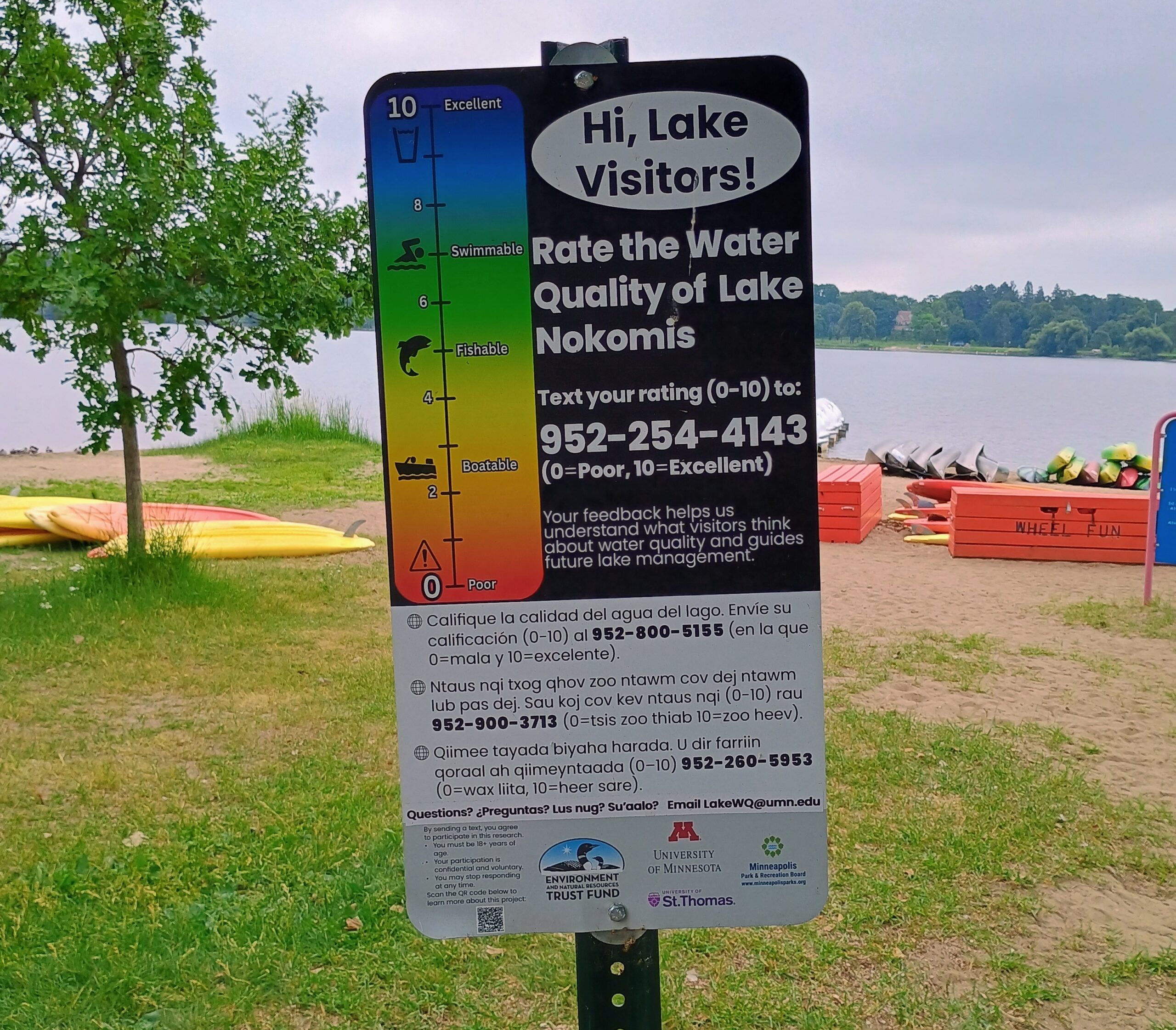

If you've been to a Twin Cities beach this summer and seen a sign asking you to text a number about water clarity, that's not spam — it's research. University of Minnesota researcher Becky Forgrave and University of St. Thomas biology professor Chip Small are running a project that tracks water quality at 17 urban lakes across the metro, including Lake Nokomis, Como Lake and White Bear Lake, while simultaneously surveying visitors on how clean they think the water looks.
The setup pairs hard science with public opinion. Students working with Small and Forgrave collect weekly water samples measuring phosphorus, E. coli and other variables that determine water quality. At the same time, signs posted near beaches and boat launches invite visitors to text a lake-specific number and rate what they see on a scale of 1 to 10, through an automated system that runs in English, Hmong, Spanish and Somali.
The point isn't just curiosity about what people think — it's figuring out whether perception tracks reality. Small said the project fills a gap: decades of public investment have gone into cleaning up Minnesota lakes, but there's been little data on whether people actually notice the improvement. Roughly 80% of the lakes removed from the state's impaired-waters list over the past 20 years are in urban areas, according to the research, yet how residents perceive that progress hasn't been well studied.
Forgrave said the survey responses could shape more than just a research paper. "People's opinions can guide research, guide policy, guide management of lakes," she said. Small added that clarity tends to drive people's snap judgments about water quality, whether or not it lines up with what's actually in the water — phosphorus and bacteria levels aren't something a swimmer can eyeball from the shore.
The project is funded through Minnesota's Environment and Natural Resources Trust Fund, the state-lottery-backed pool that voters extended through 2049 in 2024. Researchers plan to line up the survey data against water quality trends to see whether lakes that have measurably improved are actually perceived as cleaner, and whether different types of lakes get read differently by the public — findings meant to steer future conservation spending toward what actually changes people's minds, not just what changes a lab report.